Through their curiosity, creativity, empathy, and problem-solving,
they often surprise adults in the most unforgettable ways. Whether it is a funny misunderstanding,
a thoughtful gesture, or an imaginative solution, these small moments reveal how deeply children
observe the world around them.
A mother once asked her daughter to write about her job. The little girl described it by saying
that her mom stood around many men, collected money, and dealt with arguments over who should go first.
The statement sounded shocking at first, and the school quickly called the mother in for an explanation.
The truth, however, was completely innocent and unexpectedly funny. The mother worked as a
retail clerk in an auto parts store. Her daughter had once seen her during a very busy sale day.
She did not understand the products or the work itself, but she accurately remembered the scene:
customers, cash, noise, and long lines. At school, the little girl even acted out the situation perfectly,
shouting for people to wait their turn. What first looked embarrassing turned into a moment of laughter,
and the child earned praise for her surprisingly honest and observant description.
One parent walked into the kitchen and found a seven-year-old drawing all over the wall.
The first reaction was panic, assuming it was just childish mischief. But the child calmly explained
that he was making a “map of the flavors” in the fridge.
Instead of random scribbles, he had been organizing condiments and leftovers by taste, using colors
and shapes to represent sweet, sour, spicy, and salty items. What seemed like a mess was actually an
imaginative attempt to understand the world in his own creative way. In that moment, frustration was replaced by
pride and admiration.
Another parent accidentally overslept and nearly missed a child’s soccer game. Expecting disappointment
or anger, the parent instead discovered a sweet surprise. The child had placed
three small alarms in the room and left behind a note saying they did not want anything important
to be missed.
Rather than reacting with blame, the child showed thoughtfulness, planning, and kindness.
It was a powerful reminder that children can sometimes respond with more empathy than adults expect,
teaching us that understanding and care can be stronger than frustration.
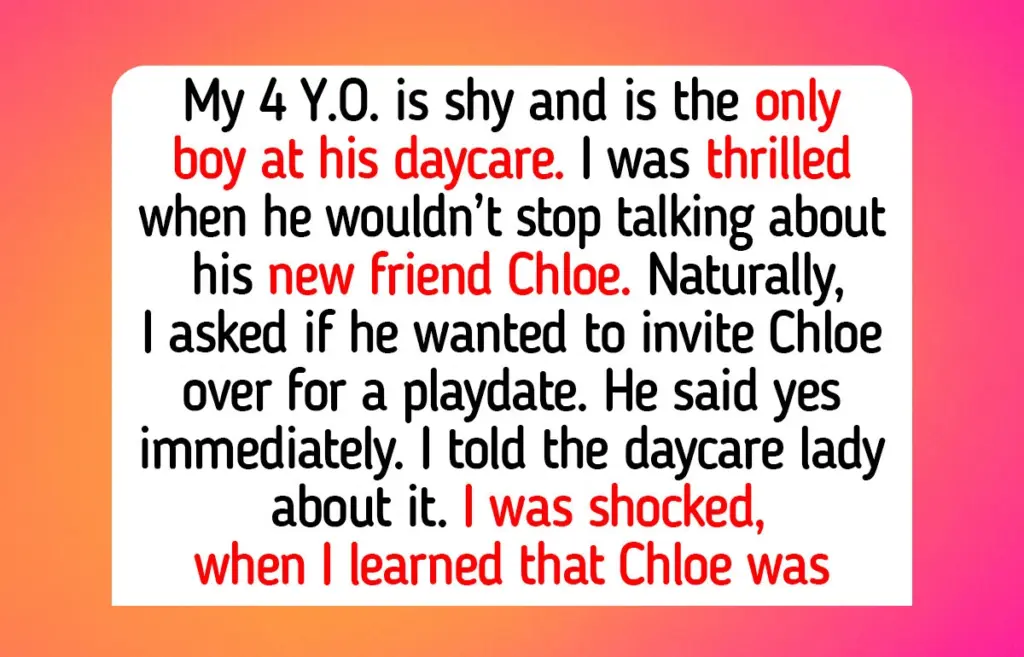
A shy four-year-old boy at daycare kept talking about his new friend Chloe. His parent was delighted
and suggested arranging a playdate. The answer came quickly and enthusiastically: yes.
Later, when the parent mentioned this to the daycare worker, the truth came out.
Chloe was not another child at all. Chloe was the daycare cat.
The moment was both funny and touching. It showed how children form connections in their own way,
often ignoring the boundaries adults assume matter. Their friendships can be wonderfully
pure, innocent, and unexpected.
One parent found a daughter crying over a broken toy and immediately assumed a replacement would be needed.
But instead of giving up, the child grabbed tape, scissors, and markers and began transforming the toy.
Soon, the broken piece became part of an entirely new design. What had looked like a ruined object
became an “upgrade” in the child’s eyes. She proudly hugged it, completely satisfied with her creation.
It was a beautiful example of resilience and imagination, showing that children often see
possibilities where adults only see damage.
Late one night, a parent expected to lecture a son who seemed unprepared for schoolwork.
Instead, the child pulled out a folded paper hidden inside a library book and explained that he had turned
the assignment into a tiny illustrated story.
The homework had not been forgotten at all. It had simply been reimagined in a more exciting form.
This moment showed how children often approach tasks with originality, proving that learning does not always
have to follow a straight line. Sometimes, creativity itself becomes the lesson.
A parent once noticed strange additions to the grocery list on the fridge. At first, the marks looked random.
But on closer inspection, the child had added stars next to vegetables, smiley faces beside fruits,
and arrows pointing toward favorite healthy items.

It turned out to be a personalized healthy eating guide. What seemed like scribbles
were actually thoughtful suggestions and preferences. The child had quietly taken part in planning meals,
revealing both awareness and care. This small act reflected how children can be more thoughtful and
involved than we often realize.
After a stressful day, one parent came home expecting questions, complaints, and a messy living room.
Instead, a seven-year-old was sitting on the floor with crayons and a notebook, carefully making a plan.
The notebook contained a full “fun day schedule” for the family, including breakfast, park time,
and even quiet reading moments for the parent. The child had noticed the tension at home and tried to help
in the only way he knew how. It did not fix every problem, but it showed a touching level of
emotional awareness, empathy, and love.
When rain ruined a planned trip to the park, one parent expected disappointment and complaints.
Instead, the child created a board game called “Indoor Adventure”.
With paper, pencils, and a little imagination, a canceled outing turned into a completely new experience.
The moment became a lesson in adaptability and resilience. Children often remind us that
disappointment does not always have to end in frustration; sometimes it can become the start of something new.
During a disagreement over a blanket, one parent expected tears and chaos. Instead, an older sibling calmly
suggested a schedule: one hour for one child, one hour for the other, and then shared reading together.
The idea worked immediately. Both children agreed, and the conflict disappeared.
It was a simple but powerful example of how children can demonstrate
fairness, negotiation, and time management without needing adult intervention.
One parent came downstairs expecting to find a child playing games. Instead, the daughter was drawing
a comic based on the family’s week. It included little jokes, everyday observations, and funny details
about everyone in the house.
Through her drawings, she revealed how she saw the family from her perspective. The comic was both honest
and entertaining, offering a glimpse into the child’s mind. It showed how children often process their world
through art, humor, and storytelling.
After a long day, one parent returned home expecting a cluttered living room and tired complaints.
Instead, the room was spotless, the cushions were stacked neatly, and the daughter sat quietly coloring.
When asked why, she simply said, “I thought it would make you happy.”
That small sentence carried enormous meaning. It was a reminder that children are often paying attention
even when adults think they are not. Their love can appear in the simplest, most heartfelt ways.
These moments prove that children are not only learning from adults; adults are also learning from children.
In their honest observations, playful creativity, emotional sensitivity, and unexpected wisdom,
children show us how to approach life with curiosity, patience, kindness, and imagination.
Sometimes the greatest lessons do not come from experience or age. Sometimes, they come from the small voice
in the next room, quietly showing us a better way to see the world.