The office is not usually where people expect to find kindness. It is often seen as a place of deadlines, stress, office politics, and emotional distance.
But sometimes, in the middle of an ordinary workday, someone shows quiet compassion, offers a small act of generosity, or creates a moment of genuine human connection.
Those moments may seem small at the time, yet they can stay in a person’s heart for years.
One employee recalled dealing with an angry customer who shouted for nearly eight straight minutes over a billing mistake that was not even their fault.
After the call ended, they sat there in silence, staring at the wall, emotionally drained.
A coworker named Jay rolled his chair over and casually said,
“That guy calls every month. Last time, he complained because the hold music was too cheerful.”
The comment was so unexpected that it made them laugh instantly.
Jay simply rolled back to his desk and never made a big deal out of it.
That tiny moment of humor became an act of rescue.
Another person was going through a brutal divorce and had reached a point where even basic self-care felt impossible.
They came to work wearing the same shirt for four days in a row and could hear coworkers whispering about their appearance, assuming they were falling apart.
The next morning, they found a high-end handheld steamer and three brand-new white shirts sitting in their desk drawer.
There was no note, no speech, and no trace of pity.
It was kindness without embarrassment.
One of the most heartbreaking stories came from a woman who suffered a miscarriage in the office bathroom.
She was in severe pain, in shock, and trying to clean the floor with paper towels, terrified that someone would walk in and force her to explain the unexplainable.
Her supervisor entered, immediately understood the situation, locked the main door, and sat on the bathroom floor beside her.
She did not call an ambulance because she knew the employee could not afford the cost.
Instead, she cleaned the floor herself and drove her to a clinic.
On the way, she said,
“You are not a medical emergency to me. You are a mother who lost someone, and we are going to grieve quietly together.”
In another workplace, a new colleague wore the same stained shirt every day, and the smell had started bothering the team.
People complained to the boss, hoping he would simply fire the man for being unprofessional.
Instead, the boss spoke to him privately and learned that the employee’s house had burned down and he was living in a tent behind a grocery store.
Rather than disciplining him, the boss brought in a suitcase of his own clothes and arranged a “laundry day,” paying for the man’s dry cleaning for an entire month.
He told the team,
“A shirt does not define a man, but how we treat a man in a dirty shirt defines us.”
One employee, age 58, was publicly humiliated by their boss, who called them a “dinosaur” in front of a group of interns because they were struggling with new software.
They spent lunch alone in the car, wondering whether they were too old to start over somewhere else.
When they returned, they found handwritten cheat sheets taped to their monitor.
The youngest intern smiled and said,
“I am not great at it either.”
Over the next week, that intern pretended to ask for help, only to quietly teach them everything they needed to know.
It was dignity disguised as teamwork.
One woman got her best friend hired at her company, only to feel deeply betrayed when that friend started acting distant after receiving a promotion.
There were private lunches with the boss, cold behavior in meetings, and deliberate exclusion from email chains.
Then HR summoned her urgently.
She expected the worst.
Instead, she was handed an envelope from the CEO’s office containing an award for top performer.
It turned out her friend had been gathering evidence that their boss was stealing credit for her work.
The HR complaint was filed against him, not her.
Later, her friend hugged her and explained,
“I had to protect you without letting him know we were close.”
Another employee received a message from HR asking them to come in immediately.
Their son was in the ICU, they had not slept in three days, and they were barely functioning at work.
They walked into the office convinced they were about to be fired for being distracted and emotionally absent.
Instead, the HR manager closed the door, slid an envelope across the desk, and said,
“The team took up a collection. It is not much, but it is for parking at the hospital.”
Inside the envelope was a card signed by 34 people, many of whom they barely even knew.
A woman whose coworker had just announced a pregnancy was privately dealing with the devastation of her third failed IVF cycle.
She smiled through the announcement, then rushed to the bathroom to cry alone.
An older woman from accounting found her there, did not ask questions, and did not force conversation.
She simply handed her a paper towel and sat down on the floor beside her.
After a while, she quietly shared that she had also lost two pregnancies.
Then she said,
“You do not have to perform today.”

One worker lost hearing in one ear after a sudden infection and became terrified of meetings because they kept missing instructions and felt invisible.
Without any formal request, the entire department began using a transcription app during meetings and displaying the text on the main screen.
The project manager casually said it would help everyone, but the employee noticed how carefully she angled the microphone toward her own face.
It was a silent accommodation delivered with grace.
Another employee received a late-night text from their boss ordering them to finish a report by 7 a.m.
Their daughter had a fever of 104, and they replied that they could not work because of a family emergency.
The boss forwarded that message to the group chat and wrote,
“Note who is not a team player.”
The employee saw it from a hospital waiting room just after midnight and felt completely numb.
The next morning, they walked into the office ready to resign.
But their entire team had already finished the report together overnight, without being asked.
It was sitting on the boss’s desk before he arrived.
A coworker placed a coffee on their desk and softly asked,
“How is your daughter?”
In one painful story, a paramedic helped a coworker who had a seizure in the break room.
He placed her safely on her side, timed the seizure, and stayed with her until it passed.
It was the correct response in every way.
The next day, HR called him in because the coworker had reported that he touched her without consent and made her uncomfortable.
The security footage cleared him quickly, but the damage had already been done.
He returned to work and from that day on treated her as nothing more than a stranger nearby.
No friendliness, no favors, no warmth.
When she later complained that he had changed, he realized that she did not understand the cost of what she had done.
Sometimes the deepest wound is not punishment, but the loss of trust.
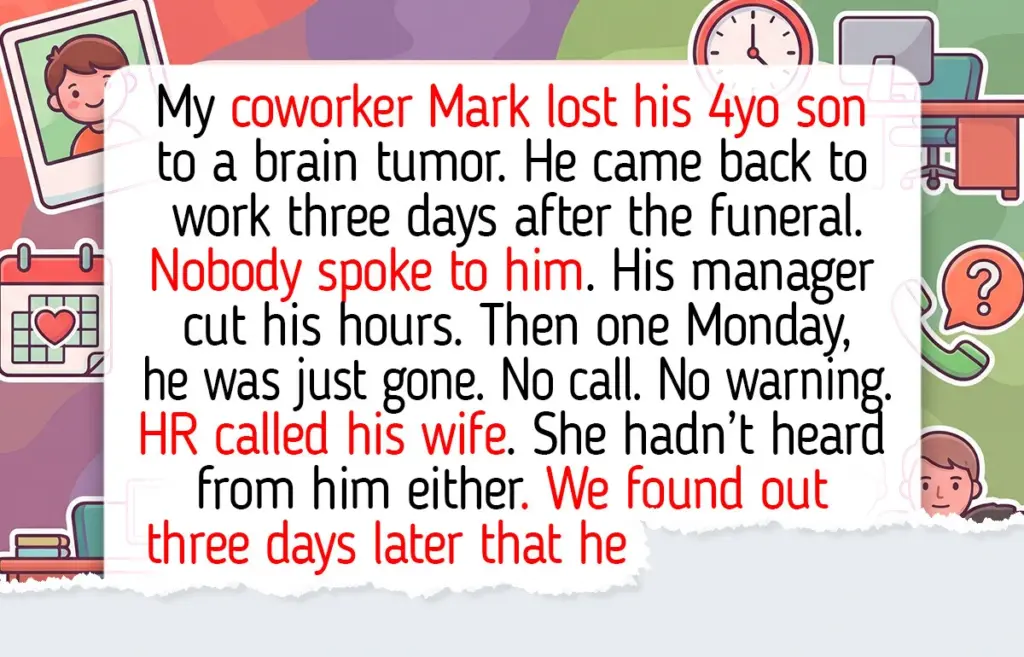
One man named Mark lost his four-year-old son to a brain tumor and returned to work only three days after the funeral.
No one knew what to say to him.
His manager even cut his hours.
Then one Monday, Mark disappeared without warning.
HR contacted his wife, who had not heard from him either.
It was later discovered that he had checked himself into a hospital.
When he returned to gather his things after being discharged, he found a box on his desk.
Inside were handwritten letters from every single person on the floor, including some coworkers he had barely spoken to.
Mark left the box there that day.
Then, the following Monday, he came back to work.
Sometimes people stay because someone finally gave them a reason to.
Another story came from someone whose colleague, Sarah, had been fired after her affair with the company director became public.
The director’s wife made one phone call, and Sarah was effectively blacklisted in the industry.
No one defended her.
The storyteller felt sorry for her but stayed silent, too afraid to risk their own position.
Three weeks later, the director died suddenly of a heart attack at his desk.
Sarah was left with nothing—no severance, no recommendation, no closure.
Years later, the storyteller walked into a job interview and found Sarah sitting across from them as the senior hiring manager.
She recognized them immediately but remained calm and professional.
The next day, she called with a job offer.
When asked why, she answered quietly,
“You were the only person who never looked at me like I deserved what happened.”
That moment became a powerful reminder that even the smallest form of humanity can remain unforgettable.
These stories remind us that workplaces are not only built from policies, performance, and pressure.
They are also shaped by people noticing when someone is breaking, grieving, struggling, or simply trying to survive the day.
Real kindness at work is rarely loud.
It often appears as a joke at the right moment, a silent gift in a drawer, a shared floor in a bathroom, a coffee on a desk, or a room full of people quietly stepping in when someone cannot carry the weight alone.