From saving dusty shoeboxes of memories to learning how to text at seventy-eight,
grandmothers have always expressed love in ways the world often overlooks.
Their kindness may not make headlines, but their quiet actions create the kind of
legacy that keeps families together long after they are gone.
These heartfelt stories show how grandmothers offer unconditional love, empathy, strength, and protection
in ways that leave a lasting mark on every life they touch.
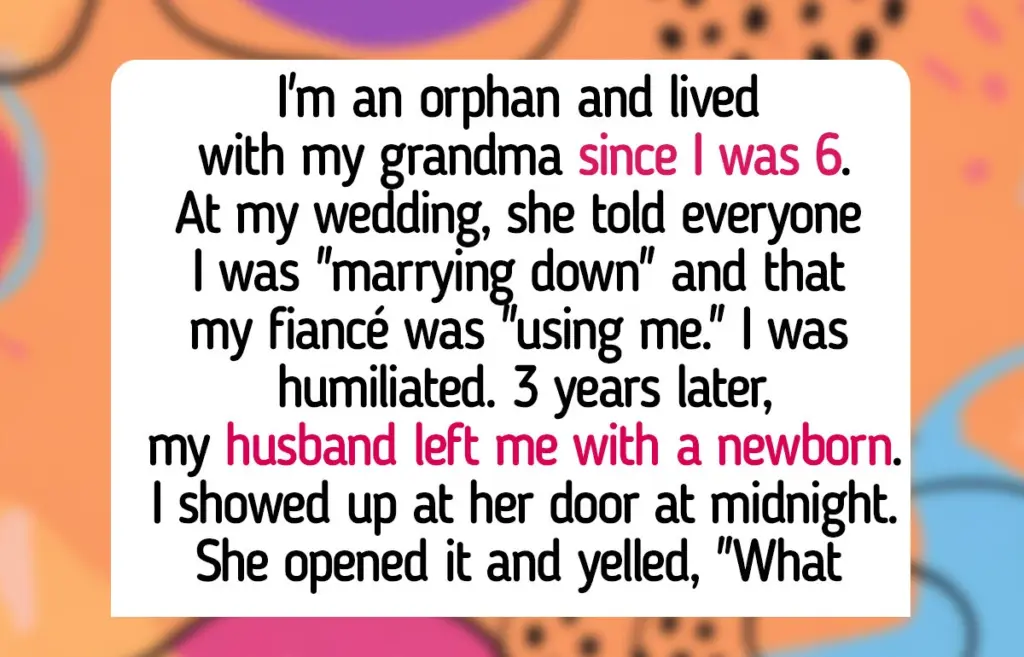
1. I lost my parents early and had lived with my grandmother since I was six.
On my wedding day, she openly said that I was “marrying beneath myself”
and that my fiancé was using me. I was deeply embarrassed and hurt.

Three years later, my husband abandoned me and our newborn baby.
In the middle of the night, I arrived at my grandmother’s house with nowhere else to go.
She opened the door and said, “What took you so long? I’ve had your room ready for months!”
She brought me inside, already holding my baby as if she had been waiting for us.
Then she showed me a nursery she had quietly prepared long before I arrived.
She admitted that she had been harsh at my wedding because she hoped I would change my mind.
When I didn’t, she decided to prepare for the day I might need her again.
She helped raise my daughter and never once said, “I told you so.”
Years later, she told me something I will never forget:
“Being right doesn’t matter. Being there when you’re wrong does.”
2. My grandmother had one unspoken rule in her house:
no one ever left without eating something.
It didn’t matter whether you were family, a neighbor, a repairman, or a delivery worker.
If you stepped into her home, you would be fed before you left.
Sometimes it was a full plate, sometimes a bowl of something warm,
and sometimes a wrapped portion to take on the road.
She wasn’t trying to impress anyone. In her mind,
feeding someone was simply how care was shown.
That small act created a kind of warmth that stayed with everyone who experienced it.
3. In my grandmother’s kitchen, there was a drawer that only the grandchildren were allowed to open.
Inside was a collection of tiny, ordinary things she had saved over the years.
There was a sticker I loved when I was five, a drawing my cousin had made decades earlier,
and even a button from my coat that had fallen off during a childhood visit.
None of it had any real value, yet every item carried the same message:
she noticed us, and she kept proof that we had been there.
4. After my grandmother passed away, we found a shoebox in her wardrobe filled with letters
she had written to each of her grandchildren over the years.
Mine included one written when I was born, another when I started school,
and one from a difficult period in my teenage years when I had felt invisible.
In that letter, she wrote that she had noticed I seemed distant and didn’t want to pressure me,
but she wanted me to know she had been paying close attention.
She had planned to give them to me at the right time but never got the chance.
Somehow, that made them even more powerful.
She had seen me, understood me, and loved me quietly all along.
5. When I moved abroad for work, my grandmother was seventy-eight years old
and had never used a smartphone before. She had no interest in technology at all.
But within two weeks of my leaving, she had asked my cousin to teach her how to send text messages.
Every morning for four years, without fail, I received a message from her.
They were simple and often chaotic: no punctuation, strange capitalization,
sometimes just a single word like “MORNING” or “THINKING”.
But each message carried the same meaning:
she refused to let distance make me feel alone.
6. In my twenties, I went through a frightening health scare.
Before doctors confirmed it was manageable, I was terrified.
My grandmother drove two hours just to sit with me in the waiting room.
We were not a family that talked openly about fear, and she seemed to understand that.
She didn’t fill the room with empty reassurances or force conversation.
She simply sat beside me in silence for three hours.
In that silence, I realized something important:
her presence was the comfort.
7. After she died, we discovered that my grandmother had saved every school report card
belonging to each of her grandchildren.
Not only the good ones, but also the embarrassing ones, the failed ones,
and the years we would rather forget. They were bundled together carefully,
labeled in her handwriting.
My mother explained that grandmother always said she wanted to keep
the whole picture of who we were, not just the polished parts.
She loved us completely, including the unfinished and uncertain versions of us.

8. After a painful family conflict, I felt deeply alone.
Years later, my aunt told me that my grandmother had spoken up for me
at a gathering I had not attended.
She didn’t create drama or make a scene. She simply said, calmly and clearly,
that she believed I had been treated unfairly and wanted the others to reflect on that.
Then she went back to making tea and never mentioned it to me.
For her, it was not something that deserved praise.
It was simply what love required.
9. During university, I once brought a close friend home for a week because
she had nowhere else to go and her family situation was difficult.
I worried it might feel awkward, but within minutes my grandmother had learned her name,
asked what foods she liked, and assigned her a special cup that was now “hers.”
By the second day, my friend was part of the household rhythm.
My grandmother included her so naturally that there was never any question of belonging.
My friend later told me that week was the first time she truly understood
what it felt like to be welcomed without conditions.
10. My grandmother was quietly religious. One evening, as a child,
I overheard her praying for a woman who had once hurt her badly.
When I asked why, she paused and said that the woman must have been carrying
something very heavy for a very long time, and someone had to pray for her.
She said it simply, without bitterness, without expecting recognition.
That moment taught me that compassion is sometimes choosing kindness
even when you have every reason not to.
11. There were periods in my childhood when I stayed with my grandmother for weeks
because my parents were dealing with things they could not explain to me.
I was a difficult child during those times — sometimes loud, sometimes withdrawn,
always carrying emotions I did not know how to name.
My grandmother never made me feel like I was too much.
She met every version of me with the same steady routines, the same meals,
and the same calm presence.
She created a world so consistent that even when I felt chaotic inside,
I could feel her structure holding me together.
That was her gift: steadiness without judgment.
12. When I was young, my grandmother used to tell me quietly that I was her favorite.
I believed it completely and treasured it for years.
After she passed away, I mentioned it to one of my cousins, who laughed and said
she had told him the exact same thing. Eventually, all eight grandchildren admitted
she had told each of them privately that they were her favorite.
Strangely, none of us felt deceived. We all understood that she had meant it each time.
She had found something unique and precious in every one of us
and made each child feel deeply chosen.
That was her brilliance: making love feel personal, never divided.
Grandmothers rarely ask for recognition. Their love often appears in
small, ordinary gestures — a prepared room, a saved drawing, a morning text,
a meal placed in front of you, a defense spoken in your absence.
Yet these small gestures become the foundation of memory, comfort, and belonging.
They remind us that the strongest kind of love is often the quietest.
Some legacies are not built through grand achievements, but through daily acts of care.
And that is exactly why they endure.